Showing posts with label Ocean Vuong. Show all posts

Saturday, April 23, 2022

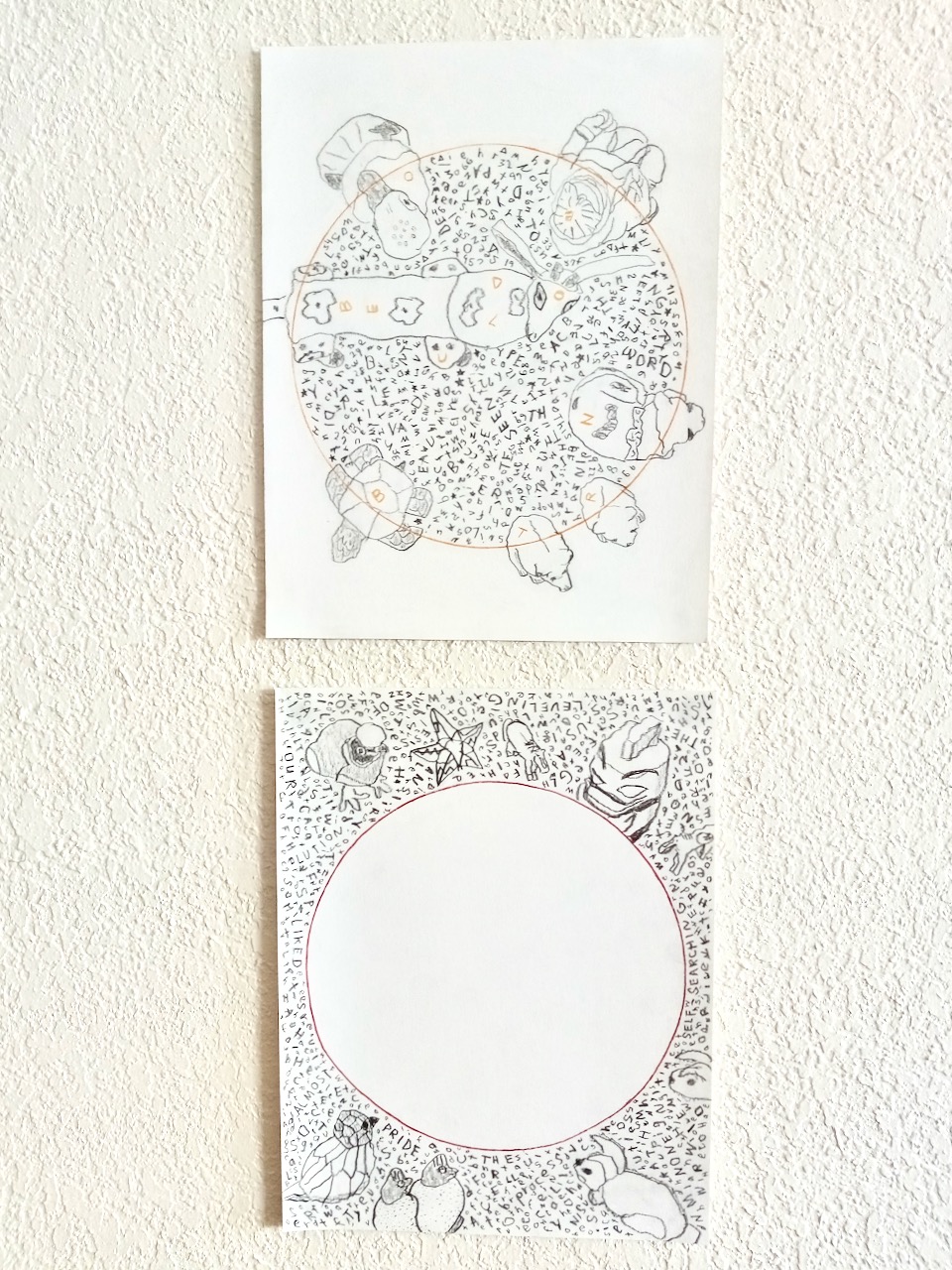
Slowly but surely / This year's mandala work using my non-dominant left hand / Two birds and one two three rabbits / Ocean Vuong's letter ("... It is said that grief is actually love, but with nowhere to go...")


*


*

Dear monastic and lay practitioners in our Buddhist communities far and wide --

In the days following Thay's continuation, I have been asked by various media outlets, as a Buddhist author, to speak on this momentous occurrence in our community. But I declined -- for what have I to say that Thay's teaching has not already solidified, already made so self-evidently clear?

His practice and life's work were always to prepare us for this moment and, in this way, prepare us for us. For our own grief in Samsara. I have always felt it wiser to do nothing than to do something without strong intention or proper conditions in place. But when Denise Nguyen, executive Director of the Thich Nhat Hanh Foundation, reached out asking to share directly to our community, this call made sense to me, to speak to you as one among you.

Language and sound, as we know, are one of our oldest mediums of transmission. The root of the word "narrative" is "gnarus," Latin for knowledge. As such, all stories are first and foremost the translation of knowledge. But not only that, they are the transmission of energy. And, as Thay taught us, energy cannot die. As a poet, this is a truth I live with every day. Because to read a few lines of Gilgamesh or The Iliad or the Tale of Kieu, is to receive the linguistic energy of a mind working up to over four thousand years ago. In this way, to speak is to survive, and to teach is to shepherd our ideas into the future, the text is a raft we send forward for all later generations. We know this because we have all clung, are still clinging, to the raft of Thay's and Buddhas's teachings. How lucky we are, as a species, to have such a vehicle. I do believe that language, despite major developments in medicine and science, is still our most advanced technology. We owe it to ourselves to commit to building new rafts for all sentient beings. Our work as was Thay's, is part of a long tradition of liberation that spans multiple epochs and myriad realms.

Yes, energy, and even people, do not truly die. But I must speak, too, as a lay practitioner, who does not yet possess the merit to devote to a monastic life, and must admit that my heart breaks to see Thay's body prepared for cremation, to know his journey through death and dying, which, as the Buddha taught us, is one of the passages of suffering all sentient beings must move through. And because I am not strong enough in my practice, I watched the procession for Thay's funeral with tears in my eyes, both for the beauty of the community he built but also for the immense sadness in my heart. I weep for myself and others who do not yet have the wisdom and merit to bear this pain well.

When my own mother was dying of cancer in November 2019, on her deathbed, she said to me, her voice weak, the heat energy already fading from her limbs, Con oi, gio con da biet noi dau nay, con phai di giup nguoi ta nghe. / My son, now that you know this sickness, you must take this knowledge to help people. My mother, though illiterate, memorized Vietnamese Buddhist sutras and would listen to Thay's teaching on her iPhone with regularity. I told her: Yes, I will not let this pain be experienced in vain. And since so many of us are feeling pain about Thay's continuation, I think it is helpful to see sadness, too, as energy. May we let the sadness come and teach us how to live. Let it be the mud for the lotus, as Thay says, Let us sit with it and let it pass through us so that it might be transformed to something like love. My mother, having learned from Thay, knew that pain can be recycled into knowledge. Isn't that what language is for?

And I ask you now, specifically of our monastic brothers and sisters, folks, and elders, as you have Xuat Gia, or "went forth," and therefore are the true pioneers of human phenomena, I ask you humbly, to seek, in your practice (as I am sure you have already done), all the ways sadness might be transformed. And we, the lay practitioners who have "remained," will follow your path. This is why monastics are, to my mind, the true embodiments of courage, are warriors more grounded and determined than anyone who has ever raised a sword: you have chosen to shave your heads and march into the vast unknown, beyond the cliff of human knowledge, while we remain here in relative safety and comfort, awaiting your discoveries, ready to go forth.

It is said that grief is actually love, but with nowhere to go. In a quest that might very well take up the remainder of my life in this form, I ask of myself and also of you, dear community: where shall we go, both within and outside us? Now that we have such a capacious raft, one that can hold so many, fortified by Thay's teaching, there might still be sadness, yes, but there is no more fear.

Knowing you are out there, mining the answers when you sit down, when you follow your breath, when you make offerings, knowing you are just ahead of us, and that I can glimpse your bright robes along the road, like scraps of sunlight among the grey detritus, how can I ever be scared? But more so, how can I ever be lost?

I am sad, yes. And I will be so for some time. My heart aches -- but despite, or perhaps because of that, I have found you. and in you I have found myself.

That is the narrative, that is the knowledge.

Yours, in hope and word,

--Ocean Vuong

Sunday, April 17, 2022

Time Is A Mother, by Ocean Vuong


 "I was made to die but I'm here to stay," writes Vuong in his second collection. It's perhaps as fitting a theme as there is to be found in the collection, a work that seeks to tease beauty from violence, to find life in pain ..."

Library Journal review

*


Sunday, December 13, 2020

Robinson Jeffers and Ocean Vuong / Mid-December views with local music

Robinson Jeffers walking near home on the California coast with his twin sons, Donnan and Garth


"... In the autumn of 1934, Jeffers received a letter from Sister Mary James Power — principal and teacher at a girls’ Catholic high school in Massachusetts. A lifelong lover of poetry, Power had endeavored to edit an anthology of prominent poets’ reflections on the spiritual dimensions of their art and their creative motive force. She invited Jeffers to contribute, asking about his “religious attitudes.” His response, originally published in Powers’s 1938 book Poets at Prayer and later included in The Wild God of the World:  An Anthology of Robinson Jeffersis one of the most beautiful and succinct articulations of a holistic, humanistic moral philosophy ever committed to words — some of the wisest words to live and think and feel by ..."

(to read the entire essay, click here)

"Response to Sister Mary James Power

Tor House, Carmel, California
October 1, 1934

Dear Sister Mary James:

Your letter should have been answered sooner, but there have been so many visitors and other events the past fortnight.

As to my "religious attitudes: -- you know it is a sort of tradition in this country not to talk about religion for fear of offending -- I am still a little subject to the tradition, and rather dislike stating my "attitudes" except in the course of a poem. -- However, they are simple. I believe that the universe is one being, all its parts are different expressions of the same energy, and they are all in communication with each other, influencing each other, therefore parts of one organic whole.  (This is physics, I believe, as well as religion.)  The parts change and pass, or die, people and races and rocks and stars; none of them seems to me important in itself, but only the whole.  This whole is in all parts so beautiful, and is felt by me to be so intensely in earnest, that I am compelled to love it, and to think of it as divine.  It seems to me that this whole alone is worthy of a deeper sort of love; and there is peace, freedom, I might say a kind of salvation, in turning one's affections outward toward this one God, rather than inward on one's self-- or on humanity, or on human imaginations and abstractions -- the world of the spirits.

I think that it is our privilege and felicity to love God for his beauty, without claiming or expecting love from him.  We are not important to him, but he to us.

I think that one may contribute (ever so slightly) to the beauty of things by making one's own life and surroundings  environment beautiful, so far as one's power reaches.  This includes moral beauty, one of the qualities of humanity, though it does {seems} not {to} appear elsewhere in the universe.  But I would have each person realize that his contribution is not important, its success not really a matter for exultance nor its failure for mourning; the beauty of things is sufficient without him.

(An office of tragic poetry is to show that there is beauty in pain and failure as much as in success and happiness.)

-- There is nothing here that has not been more feelingly expressed in my verses; but I thought that a plain question deserves a plain answer. -- Of course you are welcome to photostat this at pleasure.

Sincerely yours,
Robinson Jeffers."

*

As I read Robinson Jeffers' response, I thought of the quote that Sabine posted a few days ago:

"Do you remember the happiest day of your life? What about the saddest? Do you ever wonder if sadness and happiness can be combined, to make a deep purple feeling, not good, not bad, but remarkable simply because you didn't have to live on one side or the other?"

         Ocean Voung


*

Looking east in mid-December:


And if you have time, listen to this music from the county where I live  (population 229,247 in 2019).  Whatcom County took its name from a Nooksack word meaning "noisy waters."


Thursday, September 17, 2020

Timely and Timeless / "... We didn't perish that day in November 1972 ..." / Canoe Journey Anthem


https://vimeo.com/397256728 (if you wish to listen to an excerpt)


“Expansive in scope and feeling, The Mountains Sing is a feat of hope, an unflinchingly felt inquiry into the past, with the courageous storytelling of the present.”

Ocean Vuong, author of On Earth We're Briefly Gorgeous


As I was reading a novel obtained from our public library, The Mountains Sing, by Nguyễn Phan Quế Maiduring this past week while confined indoors due to the smoke from the fires that continue to burn on the West Coast of the United States, I was reminded of Toni Morrison, Octavia Butler, Sandra Cisneros, Linda Sarsour, Louise Erdrich, Anna Akhmatova, Virginia Woolf, Ursula Le Guin, Jacqueline Woodson, and Thich Nhat Hanh and how so many of the circumstances that we are experiencing currently have been experienced throughout known history and that human beings have survived against all odds, continuing to be challenged to find ways to live in the present moment with complexity, grief, paradox, uncertainty and song:

Canoe Journey Anthem:


Monday, May 4, 2020

"Bird Songs Of The Pacific States" by Thomas G. Sander / Multitudes / Ocean Vuong / Mandala #48: Illuminations from Childhood


The two CDs that comprise "Bird Songs Of The Pacific States" are music to my ears during this time of uncertainty and sorrow.

Several mornings ago when I went outside in the darkness, I heard an American Robin singing its spring song from the peak of the roof of the community building for our condominium complex:


Later that morning, almost home from walking up the hill and back, I heard a single Canada Goose calling.  I looked around to see where the sound was coming from and saw a Canada Goose on the roof of the building where I live.  I wondered if it could be the same one that had been on the trail the day before.  I began to wonder if something had happened to its mate.


The day before, while looking out my window overlooking Scudder Pond,  I had observed a Canada Goose guarding a section of trail over a period of several hours:


I remembered a poem I wrote in 2000, inspired by another solitary Canada Goose and thought about this year's return of the tree swallows and the red-winged blackbirds singing with all the other birds I can hear even when my windows are closed.  The American goldfinch is Washington's state bird, but I rarely see them.  Yesterday I saw an osprey high in the sky, scouting for fish in Lake Whatcom.

I remembered a few days before that when a 2-year-old boy, the son of friends of mine, looked up at me as I was walking by on the street overlooking their house.  He smiled and put his arms around himself in a hug and said, "Love you!"  With the same body language, I said, "Love you!" in return.

There is something beyond uncertainty and sorrow.

*

Do I contradict myself?
Very well then I contradict myself,
(I am large, I contain multitudes.)
-- Walt Whitman

When I listened to a very young Sinéad O'Connor singing at Sabine's blog on the first of May, it occurred to me that Sinéad's life, like the lives of so many people I respect, has shown that she "contains multitudes."  This song of hers is dear to my heart:


At the beginning of the stay-at-home order in Washington State, I began revisiting my entire cassette and CD collection of music by Bob Dylan from 1962 to 2016.  The last vinyl Bob Dylan album I bought was in 1988.  I no longer have a turntable, but I still have the complete collection of his vinyl albums from 1962 to 1988.  My cassette and CD collection is not complete but is close, with nothing missing after 1979.

My perception is that when I say that I like Bob Dylan music, it is assumed I am referring to his music from the 1960s and early 1970s.  My favorite Bob Dylan album is "Love and Theft" which was released on September 11, 2001.  There are plenty of Bob Dylan songs that I can do without, but throughout his career are songs that together carry the full range of human experience and have been lifelines for me, assuring me that I am never alone.  I love listening to covers of Bob Dylan songs on YouTube by young people who are just discovering him.

That Bob Dylan "contains multitudes" is what I have seen so far in revisiting his first 30 years of songs.  In 1991, he released Volume 3 of the bootleg series.  After the songs on "Love and Theft," those 3 CDs are next on my list of songs that are well worth revisiting.  I'm listening to songs now that I first heard when I was in my early 40s.


Call me any name you like, I will never deny it
But farewell, Angelina, the sky is erupting, I must go where it's quiet
(lyrics by Bob Dylan from "Farewell Angelina")


*

From Ocean Vuong:

I grew up right in the shadow of 9/11. It created something very interesting, because we were essentially the last generation to play outside thoroughly. Things like tag and manhunt, those things were gone overnight. I saw it with my own eyes. Our nation became a nation that dictated fear through colors: today is red; tomorrow is orange; yellow alert.

...


I think so. But I think all religions have this — outside of all of the orthodoxy and the rigor of ceremonies, at the center of it is trying to remind us that we will die; and how do we live a life worthwhile of our breath? And I think, thinking about death and thinking about what we do towards it, around it, helps me center myself in such a chaotic space. And I do think it’s part of my own nurturing of my own mental health.

...


“The poem, like the fire escape, as feeble and thin as it is, has become my most concentrated architecture of resistance. A place where I can be as honest as I need to — because the fire has already begun in my home, swallowing my most valuable possessions — and even my loved ones. My uncle is gone. I will never know exactly why. But I still have my body and with it these words, hammered into a structure just wide enough to hold the weight of my living. I want to use it to talk about my obsessions and fears, my odd and idiosyncratic joys. I want to leave the party through the window and find my uncle standing on a piece of iron shaped into visible desperation, which must also be (how can it not?) the beginning of visible hope. I want to stay there until the building burns down. I want to love more than death can harm. And I want to tell you this often: That despite being so human and so terrified, here, standing on this unfinished staircase to nowhere and everywhere, surrounded by the cold and starless night — we can live. And we will.”

*


Thursday, September 12, 2019

James Baldwin and Ocean Vuong / Leah Siegel covering Buckley covering Buckley / Learning Spanish / NAMI class


Ocean Vuong's book On Earth We're Briefly Gorgeous was brought to my attention in the last month or so, and I put a hold on a copy at our public library.  I found the book to be extraordinary as well as difficult and worth the difficulty.  Ocean Vuong, like Toni Morrison, took me to places I've never been before (but not as "a tour guide to pre-made worlds" but as a "world maker," to use Ocean Vuong's words from the interview) and changed the way I see the world.  Before finishing the book, I took a 50-minute break to listen to Ocean Vuong and Jacqueline Woodson.  Previously, while reading the book, I had listened to several other interviews with Ocean Vuong in which he reminded me of a young Bob Dylan.  In the above Strand Bookstore interview, Ocean Vuong lights a James Baldwin votive candle before the interview begins, in honor of James Baldwin's illuminating presence.  In that moment, I realized that what I was perceiving as a similarity to Bob Dylan was actually a similarity to James Baldwin.  Bob Dylan's work and way of being in the world were strongly influenced by James Baldwin.  That is what I was seeing in Ocean Vuong.  James Baldwin lives on through his literary descendants.  Ocean Vuong is one of the most recent in that literary family tree.


Some quotes from Ocean Vuong:

"... the merciful light in the midst of all this darkness ..." (from the interview)

"Let no one mistake us for the fruit of violence--but that violence, having passed through the fruit, failed to spoil it." (p. 231, On Earth We're Briefly Gorgeous)

This morning, I discovered this version of "Once I Was A Soldier" by Leah Siegel and wanted to share it.  I've never heard a woman sing that song before.


Beginning on September 4, I made a commitment to learn to speak Spanish, building on two years of Spanish in high school (escuela secundaria) 52 years ago.  There is a Spanish Conversation group that meets weekly at our local Senior Center around a table in a small meeting room and is facilitated by an engaging woman in her 60s from Mexico.  It is immersion in Spanish rather than a formal class.  I speak like a baby and that's okay!

In addition, I signed up for a evening class offered by our local branch of NAMI (National Alliance on Mental Illness).  The class is for families and friends of people who suffer from mental illness and meets two nights a week for six weeks.  My hope is to learn how to take care of myself in the numerous encounters I have regularly with people who suffer from mental illnesses and to learn how I can be supportive of those who suffer from mental illnesses.  Once again, there are no easy answers, and I am open to learning what I can.

The next six weeks will be full, with not much time for posting.  I will be reading your blogs, sending love as always.

Here's a volunteer Mimulus that appeared on my porch: