There’s a beautiful Inuit word, “qarrtsiluni.” It means “sitting together in the dark, waiting for something to happen.”
*
If you picked up something spiritual or religious in my work, it is because, even after having given up the credal belief, something about the language and the way it plumbs experience has remained intact for me.
*
One thing I do know for sure is that we all need a great deal of help. And a lot of the help that we need is in language, is in the language that has been boiled down to a quintessence so that it’s potent and effective. I continue to find a lot of that language in religious and spiritual traditions, as well as in literature and poetry — in Homer — without centering it on statements of belief, but centering it on experiences of insight or consolation.
*
Well, Virginia Woolf talks about the future being dark. Rebecca Solnit cited this. The future is dark, and that’s the best thing it can be. “The future is dark” doesn’t mean that it’s bad. “The future is dark” means we don’t know. And that, itself, is a consolation. It probably is not going to be our very worst fear. And John Berger talks about the difference between optimism and hope. Optimism is “Oh, well, it’s all gonna be fine.”
Looking up at the rest of the see-through tree, in awe of its will to live
*
Fall is clearly in the air today. After a short run of hot sunny days, the morning was cool. Halfway through my hour-long walk, as I was crossing the wooden bridge down the creek from the stone bridge in Whatcom Falls Park, I looked over the railing at the creek below. Briefly, blue sky and a cloud were reflected in the slowly moving water and then the sky above was all cloud.
*
Of Being
I know this happiness is provisional:
the looming presences -- great suffering, great fear --
withdraw only into peripheral vision:
but ineluctable this shimmering of wind in the blue leaves:
this flood of stillness widening the lake of sky:
this need to dance, this need to kneel: this mystery:
-- Denise Levertov
*
THE WAR DIARY OF YEVGENIA BELORUSETS DAY 181 (TUESDAY, AUGUST 23):
"In Kyiv, in the narrow borderland between night and day, the war seems to disappear completely, as long as no unexpected noise intrudes. That relief doesn’t come often. The war is for the most part present, with no escape from its daily persistence.
In the first weeks of the Russian invasion, I was still convinced that it would quickly come to an end, within hours or even days. Like a greeting from that initial phase of the war, I feel the fear rise within me during every air raid alarm.
I’m back in Kyiv after a long hiatus, and the wailing sirens wake me at half past three in the morning. For a few minutes I feel I must take the warning seriously. But in this violent phase of the war it’s a strange idea to go into a shelter in the middle of the night and try to find refuge from any possible danger. I smile at my restlessness, at the fact that during my stay in Berlin I had gotten out of the melancholy and fatalistic habit of maintaining my daily routines in the face of danger. Instead of going to the bunker, I shuffle with weary steps to the kitchen and make myself a cup of tea. The air raid alarm fades and a nocturnal silence settles over Kyiv, seeming to suppress the danger.
Today’s messages on the Telegram channels of Zaporizhzhia, Kharkiv, and Mykolaiv warn that the coming days will be especially dangerous. We, the Ukrainian readers, should beware. “We ask you to please take shelter if you hear the warning signals in the next few days”—it sounds like the writer is in the middle of a debate, trying to convince recalcitrant citizens with ever-new arguments.
To back up these claims, we were told that the sound of the alarm will change starting today. Church bells will chime for chemical attacks, and storm bells will ring if the threat is radioactive.
The reason for these measures is the growing tension on the front, as well as the coming holidays, especially Independence Day tomorrow, August 24. Before the war this holiday would give rise to a festive mood that lasted for days. In Kyiv today there’s chatter about the coming holiday, but much less has been said about the war’s anniversary—the war turns exactly six months old on Independence Day.
The farther you are from the war, the clearer the procession of time becomes, and you think half a year of conflict needs a special approach, a rational analysis or a case history like the ones for sick patients, in the hope of a speedy recovery.
But here in Kyiv, the symbolism of this round number crumbles when the people involved in the war—almost every Ukrainian, in one way or another—cannot afford any distance from the conflict.
Today I visited a Kyiv museum that has been converted into a shelter where volunteers make camouflage netting. Women come here every day to fasten small cloth rags to solid nylon, one knot at a time. Sometimes the volunteers’ children and their friends come and work with them. You can also spend the night here on the folding beds that rest in a single corner. One of the women shows me on her cell phone how her little granddaughter sleeps comfortably on the camouflage netting. There’s a twelve-year-old boy here whose reputation as a knotting virtuoso is growing. He ties the nets together with such speed and mastery that he’s won the admiration of the other volunteers.
Soldiers of all ranks and positions on the front come here to place their orders. Sometimes they drink tea, enjoy the company, talk and listen. Then the women visit the front line to see which nets are in particular demand. In the next room, medicine is collected and sorted for the front.
The relatives of these women—their husbands, brothers, and friends, their sisters and daughters—are at the front. I know someone who works here named Katerina, and in the mornings she also sees patients as a pediatrician in her practice near the museum. Every day, when she joins her colleagues in the museum offices, she searches the faces of others. If she sees no tears in their eyes nor any deep despair, she concludes that there is no awful news from the front and that fortunately everyone is still alive.
“Sometimes I think,” another volunteer tells me, “it would be better not to know a single person at the front. I go to sleep every night scared to death. There is no peaceful morning, no peaceful hour in my life.”
As we say goodbye, another seamstress, Natalia, begins to complain about the people in Kyiv: “Many are living as if there is no war. They do too little. They want to forget. They distract themselves and ignore the constant threat of death.” She believes that the residents of Kharkiv, in the east of the country, are thinking more clearly. She visited the city recently. “Everyone in Kharkiv knows about the death and danger, but they stay in the city. They want to save everything there is to save.”
She witnessed a rocket attack during her visit to Kharkiv, and in a somewhat dreamy manner she recounts it: “After the attack, the paramedics and neighbors and rescue services all come running, without crying, without cursing, without looking for culprits. They cover the dead with sheets, they rush the injured to hospitals, they start searching the rubble.” If they weren’t being attacked every day, if new buildings weren’t being bombed and people murdered all the time—these people would have long since rebuilt Kharkiv. She suggests that’s how incredibly brave and helpful they are.
I keep hearing that the farther away you get from the war, the easier it is to think it hardly affects anyone.
A soldier who’s an acquaintance of mine came to Kyiv from the Donbas for a couple of weeks to take a breath before returning to the front. Before the war, he worked as a programmer and wrote poetry. When we met up, he said little. I, on the other hand, told him that my friends in the small town of Toretsk, in Donetsk Oblast, have had no electricity for a week and no water since March. They’ve been fetching water from wells ever since. They wanted to flee the city long ago, but they are the only ones who can get humanitarian aid and distribute food and medicine to the people of Toretsk. Every day they postpone their departure.
The Russian attacks tend to begin at night in pitch black. The ground trembles underfoot; people begin to fear that their small houses with the narrow cellars they hide in will be destroyed any minute. During the shelling, they can’t switch on a single light, there’s no cell service, and they have to wait a long time, perhaps till the next day, before they can call someone to make sure their friends and relatives are still alive. As I explain this to him, the soldier nods in understanding. For months he’s been living surrounded by explosions with the feeling of an endless quaking around him.
In little picturesque villages, ruins line the street. Yet again the nights are like invitations for crime. The villagers are reluctant to speak of the coming winter, partly because water and electricity lines in the Donbas have been destroyed.
On Kyiv’s Telegram channels I read about Russia’s plans to attack civilian infrastructure in the coming days. The nuclear power plant in Zaporizhzhia is in danger. The American embassy warns U.S. citizens to evacuate Ukraine at once—the same warning it sent out half a year ago.
I wonder how it can be that global knowledge of these anticipated crimes—against international law, human rights, and the environment—does not help to stop them but instead becomes a pretext for new warnings.
My favorite time in the hot summer days of Kyiv is the narrow window between day and night—this threshold when the night air streams through the bright streets. I’m here and I’m enjoying every hour these days when city life marches on with all its everyday nuance."
"The diary of Yevgenia Belorusets began on the first day of the 2022 Russian attack on Ukraine. It was released almost daily for its first forty days."
At my waking time of 4 a.m. this morning I went out on my porch, as I always do, to breathe the night air and to see if the sky was clear. Always hoping to see the stars. More often than not, the sky in coastal Northwest Washington is clouded over but this morning, just as I stepped out on my porch, I was rewarded with the sight of the first shooting star I've seen in years, just as Orion was rising in the east, with the Pleiades high in the sky. For the last hour, I have listening to the beginning of cover after cover of "Shooting Star," most of them by men, hoping to find one sung well by a woman and am grateful to have found an extraordinary version by Babi Mendez at the end of my searching.
*
Then I listened to the original version, remembering the first time I heard it in 1989.
Seen a shooting star tonightAnd I thought of youYou're tryin' to break into another worldA world I never knewI always kinda wonderedIf you ever made it throughSeen a shootin' star tonightAnd I thought of youSeen a shootin' star tonightAnd I thought of meIf I was still the sameIf I ever becameWhat you wanted me to beDid I miss the markOverstep the lineThat only you could seeSeen a shooting star tonightAnd I thought of meListen for the engineListen for the bellAs the last fire-truck from hellGoes rollin' byAll good people are prayin'It's the last temptationThe last accountLast time you might hearThe sermon on the mountLast radio is playin'Seen a shooting star tonightSlip awayTomorrow will beAnother dayGuess it's too late to say the things to youYou needed to hear me saySeen a shooting star tonightSlip away
*
*
I've come a long way since 1949, since 1951, since 1954, since 1963, since 1966, since 1971, since 1987, since 1989, since 1994, since 2001, since 2003, since 2008, since 2020, since yesterday.
Grateful.
*
And something more, with gratitude to Robin for her comment with the word beshert which led me to a short film which shed light on the mysteries of the relationship between R and I and left me weeping with joy. No wonder I continue to feel gratitude to him. R and I were born within 24 hours of each other in 1949.
Whatcom Falls Park restroom mirror self-portrait (-:
*
The Canadian Cascades are visible through the trees at the top of the hill on this unusually clear day.
*
Art that appeared along the trail in the past few days.
Dome spider web
*
Looking up to the left of the trail
*
Cooling my feet in Lake Whatcom at the end of the walk
It's been a long journey, 73 years in early October. Although I'm healthy, I'm putting my affairs in order, as they say. A few days ago, I signed up for a pre-paid cremation. It was sobering and liberating at the same time to give information that will appear on my death certificate.
My friends are close to me in age or older and now that I have a reverse mortgage in place as well as other fairly simple but time-consuming financial complications, I'm updating my will and making a trustworthy local company my Power of Attorney for Finance as well as the third party to contact if neither of my first two executor choices are available. I've had a Power of Attorney for Healthcare in place for some time. My parents put their affairs in order long before they died. I deeply appreciate that they did that. I am single and have no children or close family except a dear first cousin, born a month and a half after me, who lives locally. I have a photo of us in 1950 in Minneapolis. My parents drove from California for a rare visit with my father's family.
I'm grateful for a few good friends near and far.
Every day a gift. That's for sure.
*
I dreamed last week that my father came to my door with a message. He was younger than I ever remember him being. He was clearly who he was before he was my father, probably in his 20s. He was 35 when I was born. He looked as if he had come a long way with his message. Slightly out of breath from exertion and a little disheveled, he told me that life goes by very quickly and that one must be kind, especially in the last years of life. Having said that he rushed off to the right and disappeared around a corner wall.
*
Can't resist posting this song about being happy to just to be alive. Bob Dylan's music has been in the background of my life since I first heard his voice on TV on August 28, 1963, during the March on Washington for Jobs and Freedom, when I was 13-going-on-14-years old. He's "a man of contradictions," "a man of many moods." He "contains multitudes."
When my mind churns up old thoughts that interrupt the joy I feel walking in the woods, I say to my mind, "Tell me something I haven't heard before."
My mind becomes quiet. It has nothing new to say. The sounds all around me become exquisitely clear.
This works under all circumstances (-:
*
Something made me wonder if I had posted something like this before, and I found this poem I wrote nearly 20 years ago after a group sitting meditation in a local meditation hall and posted here in 2015.
POEM ABOUT SOMEONE AND SOMETHING NEW
Someone breathing
Someone not alone
Someone walking lonely paths
Someone leaving lonely shelters
Someone finding a lonely ocean
Someone feeling Something New
Thousands of tiny hearts
Within the left side of Someone
Someone's right side perfectly empty
Someone's emptiness graceful as sky
Thousands of tiny hearts
Filling half the emptiness
Something loving the emptiness
Emptiness loving Something
Yes and No becoming simple again
Something New becoming emptiness
Emptiness becoming Something New
Something New and emptiness finding Someone
Someone finding the seasons of a lonely path
Someone finding shelter from a lonely storm
Someone finding a lonely ocean
With Someone sleeping, there was still Something New
Not sure why I watched this movie the first time. I know that I found it puzzling and unsettling. Not sure when I watched it the first time, although it was made in 2010. Recently Smetana's "Moldau" was brought to my attention by Sabine in a comment she made here. It sounded familiar. With a little Googling, I found that it was used in the soundtrack of "The Tree of Life." Something moved me to check out a copy of the DVD from our public library. This time, it was nearly unbearable to watch and I almost turned it off, but I sensed that fully experiencing the feelings it evoked would move me forward and bring healing. That is just what happened.
I'm watching it a third time from a new perspective. All that was then. All this is now. I've come a long way from the frightened child who felt unloved, who hated herself and had little hope of anything ever changing. I'm not a religious person. This movie is set in a Judeo-Christian context. Still, it speaks to me at a time that I need to hear what it has to say about families and grief and nature and grace and, most of all, love.
*
After discovering this song as it was churned up by my YouTube channel, I had to look up the word humanist and found that there are some humanists who are religious and that most humanists have strong religious backgrounds.
Coincidentally, in this context, I recently listened to an intriguing facilitated conversation between a religious person and a scientist. I am neither and yet I relate to what both people say.
*
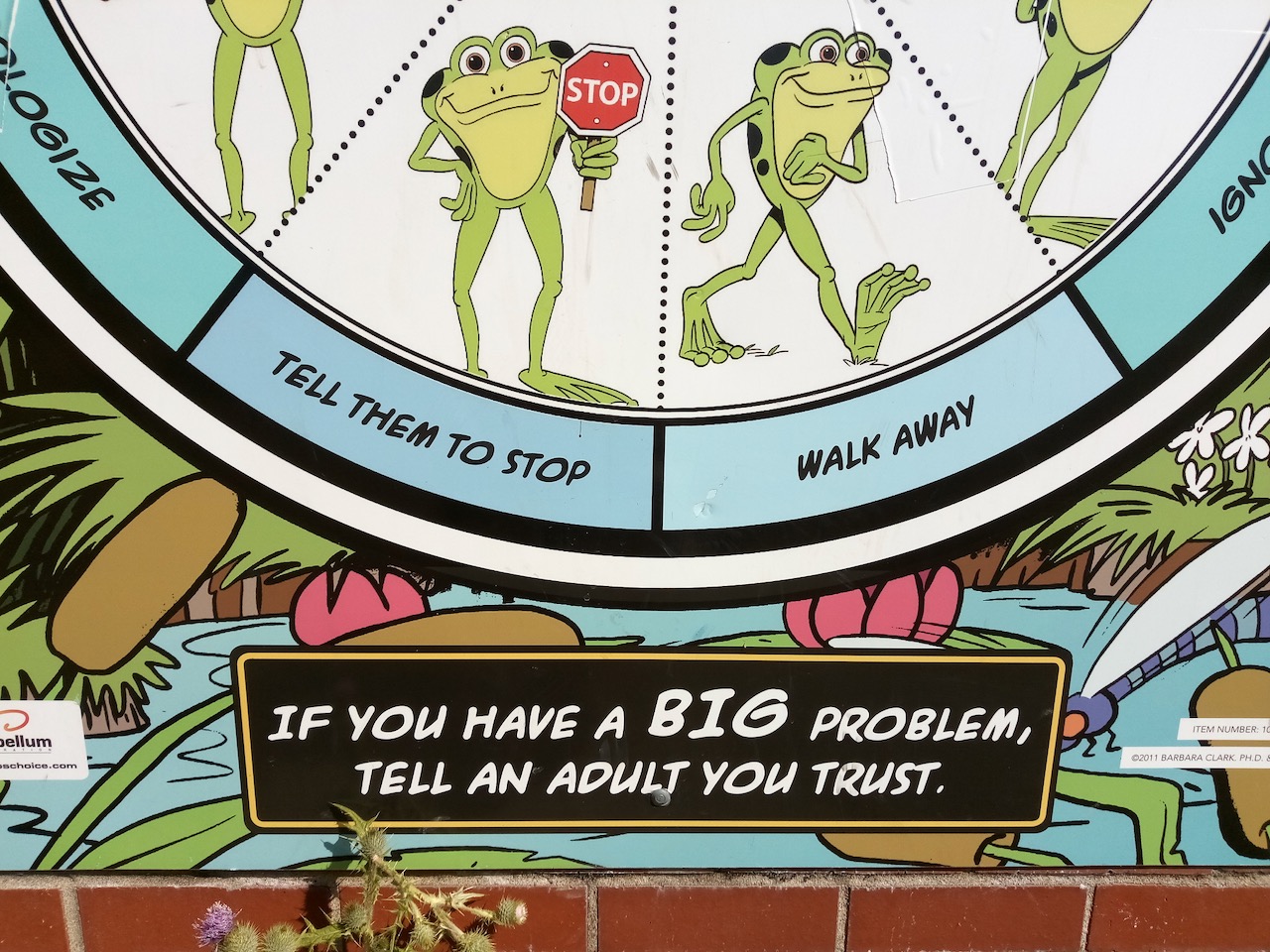
I visited the elementary school up the street and looked at the mural on an outside wall of the school and the suggestions for children on the other side of the playground. I remember how lonely and frightened I was in at home and in elementary school.
There were no adults I felt I could trust. I wonder what I would have thought if I had seen these suggestions as a child, most of which were beyond my power to carry out. Nevertheless, they are good suggestions.
*
Here is the tree I donated to Big Rock Garden, which is within walking distance of the elementary school. There is a trail through the woods from Big Rock Garden to the school. The tree will be growing long after I am gone. I am learning to trust. I am learning to take the suggestions offered. Never too late.
A friend went to a local concert where a cuíca was played. She described the instrument as a "tin can." I found a video showing how to make a cuíca from a tin can. I found another video showing a more formal version of a cuíca as a featured instrument.
My friend told me that it sounded something like a bird. It makes me think of sound effects on the Saturday morning cartoons I watched as a child in the 1950s and makes me smile today.
Looking at the early morning sun through the cottonwood trees and looking at what the sun lights up.
*
Any day now, Orion will rise before dawn. Already I can see the Pleiades. I look forward to seeing Orion every year in early August.
*
A few days ago, my first cousin and her daughter (my first cousin once-removed) whose oldest son is about to go away to college and I were talking while sitting on some cement steps just above tide pools on the east side of Bellingham Bay. We saw three black oystercatchers fly by and then one flew back to the tide pools. I don't recall seeing oystercatchers here before. I did find a YouTube video of a single oystercatcher, filmed north of here in British Columbia. A charming elegant bird with a squeaky voice you can hear at the end of the video.
My mother sang, "Go to sleepy, little baby ..." Her mother must have sung that song to her. I don't remember my mother singing anything except that song.
My father sang only the choruses to songs he would have heard as a child and teenager, "Barney Google, with the goo-goo-googly eyes ..." and "Come Josephine in my flying machine and away we'll go, away we'll go ..." Both of these songs annoyed my mother, but they made me smile.
(My mother's name was Josephine.)
Every time I asked my father if he would buy me a horse, he would sing these words, "When your hair has turned to silver, I will buy a horse for you." My father would have heard that song when he was in high school.
*
Besides those four songs, I don't recall any singing in our home. I must have heard hymns and organ or piano music from ages 2 to 3 at church but have no clear memory of music as an important part of my early life until my father bought our family a television in 1953 or 1954 when I was 3 or 4 years old.
I went to YouTube to find the music and songs that I remember hearing on television and in Disney movies, which were the only movies we were allowed to see.
Then there was Elvis Presley:
Listen for Flight of the Bumble Bee, by Nikolai Rimsky-Korsakov:
Much of the instrumental and vocal music I remember came from Walt Disney TV shows and Walt Disney movies, notably "Fantasia."
There was nothing that captured my attention and inspired awe more than hearing Mahalia Jackson for the first time as I was playing quietly in our living room and heard her distinctive voice. I was moved by the sound of her voice in a way I had not been moved before by any singing I had heard previously but did not hear her voice again for many years.
From age 6 on, I listened to rock and roll on the radio and on television with a passion. I was unable to carry a tune but did my best to sing along with other children during music time at school. I was not chosen to be in glee clubs when I tried out at two different times and I gave up on singing. I scored so low on musical instrument aptitude tests that they gave me rhythm sticks and then they found that I couldn't keep the beat.
Still I loved the music on the radio, finding it a necessary and positive part of my life.
*
I am curious to know what part music played in the early lives of others in this blogging community.
What is the first music you remember hearing? Was music important to your parents? Were there music instruments in your home?
How can I be useful, of what service can I be? There is something inside me, what can it be? -- Vincent van Gogh (1853-1890)
Welcome to "37TH DREAM (RUMORS OF PEACE)".
The photograph currently at the top of my blog was taken from my porch before sunrise on October 29, 2023.
"OLD GIRL OF THE NORTH COUNTRY" (the earliest name for my blog -- http://oldgirlfromthenorthcountry.blogspot.com
) came to life in early December of 2006 so that I could post a 42-year retrospective of my paintings and drawings and through that action, create a new relationship with the day the man I loved returned from Vietnam in December 1970. For a while (sometime after spring of 2008, which is when he died) my blog was "TALKING 37TH DREAM WITH RAINBOW (RUMORS OF PEACE)". For a number of years, it's been "TALKING 37TH DREAM (RUMORS OF PEACE)." As of April 12, 2017 my blog was titled "37TH DREAM / TALKING 37TH DREAM (RUMORS OF PEACE/LOOKING UP)". Somewhere along the way it became 37TH DREAM (RUMORS OF PEACE).
To begin viewing the retrospective with narrative, scroll down to December 8, 2006, on this page:
I believe that unarmed truth and unconditional love will have the final word in reality. This is why right temporarily defeated is stronger than evil triumphant. -- Martin Luther King, Jr. (1929-1968)
All journeys have secret destinations of which the traveler is unaware. -- Martin Buber (1878-1965)
It is only a little planet, but how beautiful it is.
-- Robinson Jeffers
The true end of a war is the rebirth of life; the right to die peacefully in your own bed. The true end of war is the end of fear; the true end of war is the return of laughter.
-- Alfred Molano
Enjoy every sandwich -- Warren Zevon (1947-2003)
Not in God's wilds will you ever hear the sad moan, "All is vanity." No, we are paid a thousand times for all our toil, and after a single day spent outdoors in their atmosphere of strength and beauty, one could still say, should death come — even without any hope of another life — "Thank you for this most glorious gift!" and pass on.
-- John Muir (1838-1914)
Philip Henslowe: Mr. Fennyman, allow me to explain about the theatre business. The natural condition is one of insurmountable obstacles on the road to imminent disaster. Hugh Fennyman: So what do we do? Philip Henslowe: Nothing. Strangely enough, it all turns out well. Hugh Fennyman: How? Philip Henslowe: I don't know. It's a mystery.